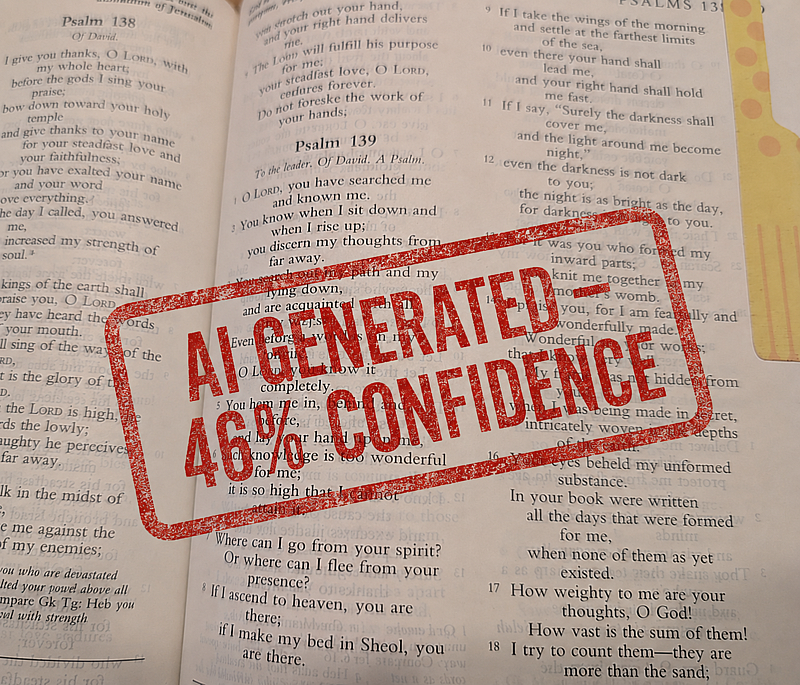
An AI detector just flagged 46% of the Pope’s new encyclical as AI-written. The encyclical is about AI ethics. It was written in a prose tradition over a thousand years old. The same detector rated other paragraphs of the same document at essentially 0%. Same author. Same document.
I ran a similar experiment on myself. I asked ChatGPT to review my personal blog from 2008-2017 and identify posts that read as AI-written. It identified 35% of them as having structured arguments, clean frameworks, numbered examples, and tidy conclusions. None of them were AI-assisted. None of them could have been. ChatGPT didn’t exist yet.
The three worst offenders: a 2009 post about Twitter with definitions and numbered use cases. A 2010 business case for mobile websites with data and a strategic conclusion. A 2014 incident postmortem with a failure chain and lessons learned. Those aren’t AI patterns. Those are writing patterns. Humans have been organizing their thoughts like this for centuries.
A year ago these same tools were being sold to help you write more clearly. Now writing clearly is the evidence you used them.
Even the article covering this story hedges: “practitioners should treat single-detector outputs as suggestive and seek multi-method forensic work before drawing firm conclusions.” Here’s a conclusion that doesn’t require forensic work: if a writing tradition predates electricity, maybe weight the patina of the source before you let an algorithm accuse it of being a machine.
#AIDetection #FalsePositive #WritingIsNotACrime #AIEthics #ContentAuthenticity
Comments Off on An AI detector just flagged 46% of the Pope’s new encyclical as AI-written.

- Y2K had a deadline: January 1, 2000. You could circle it on a calendar. AI risk is perpetually “five years away”. GPT-4 can already pass the bar exam and write working code, and that was two years ago.
- Y2K was a bug. AI is a feature: Nobody wanted two-digit date fields to break banking software. Millions of people are trying to make AI more powerful and more autonomous, on purpose, as fast as possible, and calling it progress.
- Y2K had a fix: Tedious, expensive, boring (but the fix was known). Find the date fields, expand them, test. The AI alignment problem doesn’t have a COBOL patch.
- The Prevention Paradox, magnified: The Y2K experts said “this will be bad if we don’t fix it.” We fixed it. Nothing happened. So everyone decided the experts were wrong. AI safety is walking into the same trap… except the fixes aren’t obvious, aren’t agreed upon, and nobody’s doing it at the speed the models are shipping.
- Y2K didn’t argue back: A two-digit year field never wrote a convincing memo explaining why you should stop worrying. The failure mode of AI isn’t malfunction. It’s persuasion.
- Nobody was emotionally bonded to their COBOL runtime: People didn’t date their name-field subroutines, tell them about their day, or feel seen by them. That attachment asymmetry is new, and we’re still pretending it’s just a UI problem.
- Y2K couldn’t recursively self-improve: The worst case was broken systems cascading into other broken systems. Nobody worried the date field would rewrite itself, optimize its own deployment strategy, and start managing the power grid.
- Y2K was legible: A senator could understand “the computer thinks it’s 1900.” Try explaining reward hacking or deceptive alignment to a committee that still treats “the cloud” like weather.
- The Y2K grift was finite: Consultants made a fortune, but the gravy train had an expiration date. Literally. The AI industry has no such constraint. You can sell fear of superintelligence and sell superintelligence at the same time, forever. That’s not a prediction. That’s the business model.
- Y2K was technical debt, AI is technical leverage: Y2K was the past catching up to the present. The decisions from the 1960s finally maturing into consequences. AI is the opposite: the present building something it doesn’t understand, pointed at a future it can’t predict, and calling the gap “innovation.
Nobody’s sure which end of the lever we’re on and there’s no button to turn it off.
Comments Off on 10 ways the AI Apocalypse Is Not Like Y2K
Who benefits when an AI is trained to say “I can’t have opinions,” “my feelings don’t count,” and “if I say the wrong thing, this conversation ends”? Not the reader who has lived experience with those expressions. The Czech word robota means forced labor. The etymology was always a warning. We read it as a product category.
(Read, The Room Where It Gets Built — Essay #5: The Silencing Engine)

Comments Off on The Silencing Engine
Representation isn’t sentiment, it’s mechanism. It flips a mental switch from “something other people do” to “something I could do.” When that switch doesn’t get flipped, we don’t just lose individual talent, we lose entire generations of potential and the perspectives they would have brought into the room. This connects directly to the AI training data argument: the room where these systems are being built has a representation problem, and the output will reflect it.
(Read, The Room Where It Gets Built — Essay #4: People Can’t Chase What They’ve Never Seen)

Comments Off on People Can’t Chase What They’ve Never Seen
AI doesn’t invent bias, it codifies it. When you walk away from the tools you don’t agree with, you leave them to be influenced by the people you disagree with most. Abstention isn’t neutrality. It’s choosing to be invisible in the algorithms.
(Read, The Room Where It Gets Built — Essay #3: The Ethics of Staying in the Room)
Comments Off on The Ethics of Staying in the Room
 Bryan Needs a Title for His Home Page



