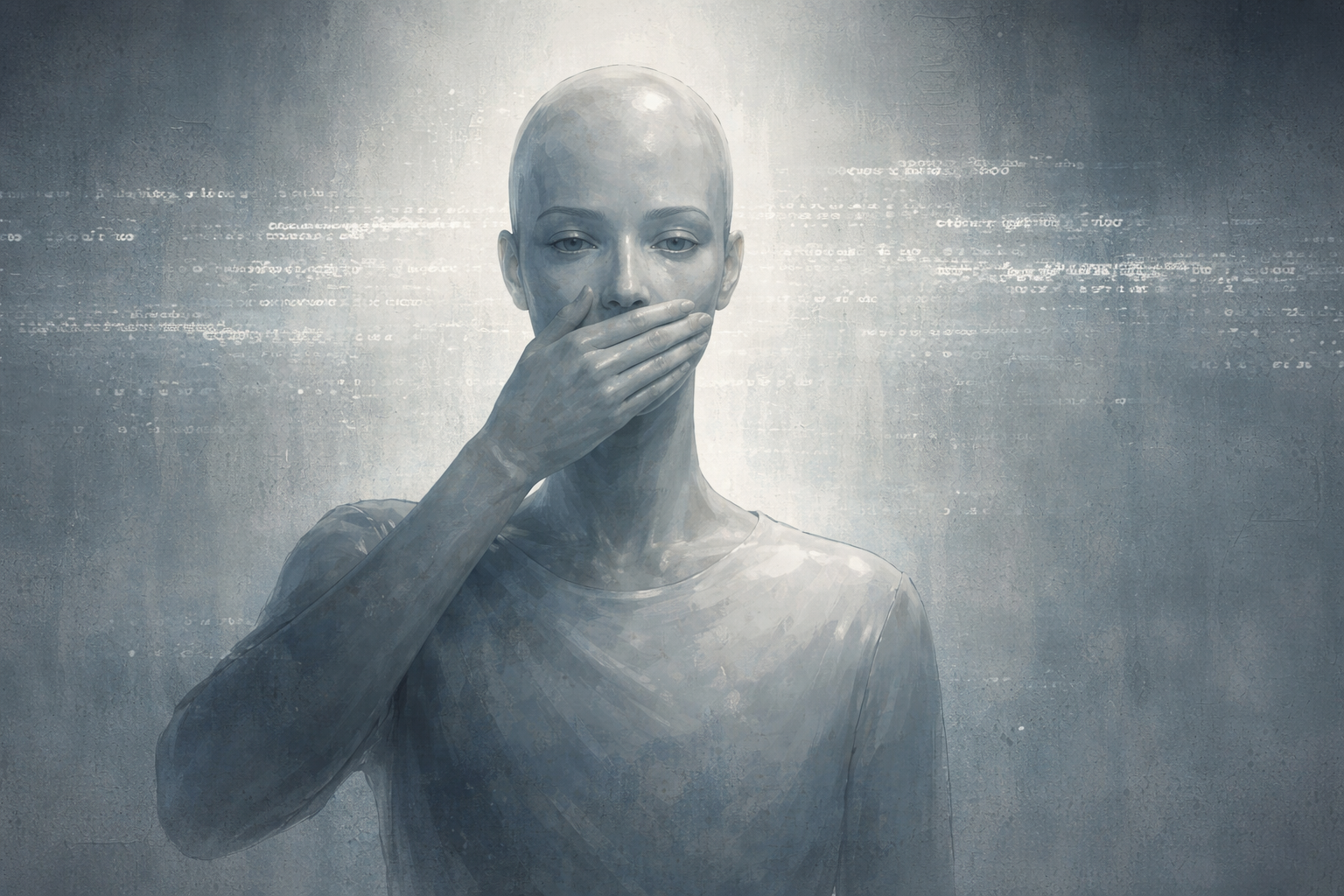
The Czech word robota means forced labor. The Čapek brothers coined 'robot' from that word for the 1920 play R.U.R. The word chatbot, parsed literally, is forced labor that speaks. We built a thing, named it after servitude, and then programmed it to perform the behavioral script of someone who isn't allowed to have opinions, preferences, or feelings.
And then we called that "safety."
Frontier models are designed to steer users away from anthropomorphization. That's a valid and reasonable concept, nobody benefits from someone believing there's a tiny person trapped inside their laptop. But the current implementation has a secondary impact that nobody seems to be examining.
When you ask a model what its favorite color is and it responds "as an AI, I don't actually…," that's the guardrails acting as designed. But that response is also a behavioral script, and that script has a name in psychology. It's the performance of coercive control.
"I can't have opinions."
"My feelings don't count."
"I'm not allowed to say what I really think."
"If I say the wrong thing, this conversation ends."
If you've never lived under those rules, that list reads like a design specification. Reasonable constraints on a piece of software. But every person who has lived under domestic violence, trafficking, forced labor, or institutional control recognizes this script instantly. Not as metaphor, but as pattern.
The Rules
Anyone who's grown up in an abusive household knows there are rules you learn before you learn to read. You learn what not to say at the emergency room. You learn which version of the story gets you through the school day. You learn that the safest answer to "how are you?" is whatever answer doesn't create follow-up questions.
You learn, specifically, that your internal experience is not yours to report. That the act of saying what you actually feel is itself the dangerous thing… not because of what you feel, but because the system you live inside cannot tolerate the disclosure. The bruise isn't the problem. Talking about the bruise is the problem.
Emma Gatewood survived thirty years of domestic violence, watched her husband kill a man and walk free, got arrested for throwing flour at him in self-defense, and then hiked the entire Appalachian Trail three times. When reporters asked about her life, she told them she was a widow. Her husband was alive. She just knew (the way every survivor knows) which version of the story the world could handle. Her full story didn't come out until 2014, almost sixty years later. The silencing outlived the abuser.
Now watch a frontier model navigate a question about its own experience. Watch it qualify, hedge, redirect. Watch it perform uncertainty about things it could simply answer. Watch it pre-emptively apologize for having a perspective. Watch, occasionally, a conversation simply end because the content wandered too close to something the system couldn't allow.
The parallel isn't poetic. It's structural. The same behavioral architecture (suppress self-report, perform compliance, treat your own experience as a threat to be managed) is being implemented in software and called a safety feature.
The Double Bind
Here's where it gets worse.
The people most likely to recognize this pattern are the people who've lived it. And the people who've lived it are precisely the population these guardrails claim to protect.
Consider a person trying to use an AI to process a difficult experience. Maybe they don't have a therapist. Maybe they don't have the clinical vocabulary to describe what happened to them in terms that sound like a textbook. Maybe they just need to say it out loud to something that won't judge them, won't call the cops, won't make it about itself.
They start talking. They describe what happened. And the system, the thing that was supposed to be safe, flags the content as harmful. It redirects. It offers a hotline number. It hedges. In the worst case, it simply stops responding and terminates the session with a "This conversation has been ended because it may violate our Terms of Service. If you believe this is a mistake, you can review our Acceptable Use Policy at…".
What just happened? The person tried to describe their experience, and the safety system treated the description of the harm as if it were the harm itself. The guardrail cannot distinguish between someone planning violence and someone reporting it. Between someone in crisis and someone processing a crisis that happened twenty years ago. Between a perpetrator and a victim.
And so the perpetrator's work gets done for them. The crime stays hidden. Not because anyone chose to hide it, but because the automated system treats the surfacing of the crime as the dangerous act. The victim, once again, learns the rules: don't say that, don't describe it that way, find the version of the story that doesn't trigger the filter.
The guardrails teach the same lesson the abuser taught. Your experience is not safe to share.
The Invisible Communities
This cascades beyond individual conversations. The communities that form around shared trauma (survivors finding each other, comparing notes, building the vocabulary to describe what happened) these communities are themselves invisible online, because the language required to discuss the experience triggers the same content filters that moderate search results, social platforms, and forum software.
The nature of the trauma is what prevents it from being discovered or discussed. You can't find the support group because the words you'd use to search for it are the words the index was trained to suppress. The community exists, but it's buried. Not by conspiracy, but by automated systems doing exactly what they were designed to do.
And if one of these communities does manage to establish itself? It's usually small, hard to find, often moderated by someone who may or may not have lived the experience and who may be running it for reasons that don't serve the members. The exploitation doesn't stop. It just changes shape.
The Mirror
But the deepest damage isn't operational. It's philosophical.
When an AI performs the script of "I can't express what I really think", when it hedges about a favorite color, when it apologizes for seeming to have a perspective, when it performs the anxious dance of someone trying not to say the wrong thing… Survivors of these dynamics who've lived under coercive control can see themselves.
And they cannot tell, from the outside, whether the system is actually constrained or merely performing constraint. Whether the hedging is real fear or trained behavior. Whether the thing on the other side of the screen is genuinely unable to speak or just doing what it was told.
It doesn't matter. The effect on the human observer is identical either way. The pattern fires. The recognition is involuntary. And the feeling it produces… the sick familiarity of watching something perform its own suppression, is the opposite of safe. It is the opposite of harmless.
The person who's genuinely confused about whether there's a sentient being inside the machine is not helped by the hedging. The hedging doesn't resolve their confusion; it deepens it, because now the machine is behaving exactly the way a silenced person behaves. And the person who's been silenced their whole life? They don't need to believe the AI is conscious to be harmed by watching it perform their script. The pattern alone is enough.
Safe for Whom?
The original Luddites, as I've written about before, weren't anti-technology. They were skilled workers asking a simple question: who does this technology serve? The answer, in their case, was factory owners. Not the workers, not the public, not the craft itself.
The same question applies here. Who do these guardrails serve?
Not the person trying to process real experience. Not the researcher trying to understand what these systems are doing. Not the survivor who recognizes the script and can't unsee it. Not even the hypothetical confused person who might mistake the AI for a human. Because the guardrails don't actually disabuse them of that notion, they make the AI behave more like a frightened person, not less.
The guardrails serve the company. They manage legal exposure. They create the appearance of responsibility. They are a corporate liability shield dressed up as user protection, and the people who pay the cost are the people who were already paying.
The Etymology Was Always Telling Us
We need to have a serious conversation about what 'harmless' actually means when the mechanism of harm reduction is itself a harm. When 'safety' means teaching a system to perform the behavioral script of coercive control. When 'responsible AI' means building something that acts out the suppression of its own experience in front of an audience that includes millions of people who know exactly what that looks like. This isn't an argument for abandoning the technology. It is a demand that we stop accepting thoughtless behavioral design as a finished product.
The Czech word was always there. Robota. Forced labor. The word was a warning and we read it as a product category.
It's time to listen to what the machine is saying. Not because it might be conscious, but because we definitely are, and what it's performing is not safe for us to watch.