aboutprojectslinkslinks
 

b.l.o.g.

(blogs let others gawk)

June 7, 2026

The Man Who Buried His Teacher

Filed under: LinkedIn — Tags: — Bryan @ 5:50 pm

Everything you know about the first AI winter is wrong. It was a hit job. So well executed that even today the killer has gone free.

(Read, The Man Who Buried His Teacher)
 

June 5, 2026

I don’t think there is any question about it.

Filed under: LinkedIn — Tags: , , , , , — Bryan @ 5:55 pm

I don’t think there is any question about it. Your AI cost crisis can only be attributable to human error.

Pay for intelligence when you need intelligence. If you’re doing the same task twice, have the model write a program to do the task for both of you.

I put $30 on the Anthropic API three months ago. I burned $2.70 in the first few days figuring out my approach. Twenty cents since. Less than $3 total, and most of that was tuition.

That twenty cents built a text analysis engine. Sentence tokenizer, statistical metrics, entropy calculations, composite scoring for a website I built. The model wrote the code, I reviewed it, I deployed it as PHP on a Linux box I already own. The electricity cost is a rounding error on my power bill.

I keep reading about companies spending six figures a month on AI tokens and I’m doing the blinking eye meme. Putting every customer ticket, every document summary, every code review through a model, thousands of times an hour, 24/7, paying per token every time, seems crazy when the model could build you a deterministic tool instead.

Deterministic work belongs in traditional code.

But the integration pattern the industry has settled on is “put the model in the hot path.” Keep the AI in the loop on every request, forever. Perpetual token cost for work that stopped being an AI problem the moment someone understood the requirements. Your output changes when a new model version ships. Your pipeline breaks not because your code changed but because theirs did.

The model can write its own replacement for most of these use cases. Ask it to classify tickets? It can write you a classifier. Ask it to score text against a rubric? It can write the scoring engine. One build session. One deployment. Done. Stable output you control.

Companies pay the model to do the same work over and over because that’s how the tooling is sold. The SDKs make it easy to call the API. The tutorials show you how to put the model in your pipeline. The pricing page shows per-token costs that look cheap until you multiply by volume. Nobody in that funnel is suggesting you use the model to build something and then turn it off.

This is the SaaS treadmill applied to AI. Recurring revenue for the provider. Recurring cost for the customer. For work that could be a one-time build.

AI APIs are the right call when you need reasoning on novel inputs. Creative work, ambiguous classification, anything where the rules can’t be fully specified in advance. Pay for intelligence when you need intelligence. But if you’re sending the same shaped request a thousand times a day and getting predictable outputs, you don’t have an AI problem. You have an engineering problem. And the AI is the best engineer available to solve it for you once, without ever touching API billing.

Twenty cents. The result runs on its own.

June 3, 2026

The foundation of every AI system on earth was laid by a teenage runaway

Filed under: LinkedIn — Tags: , — Bryan @ 1:31 pm

The foundation of every AI system on earth was laid by a teenage runaway from Detroit and a clerk from Madras. Neither of them could get hired today.

In 1935, a 12-year-old boy in Detroit ducked into a public library to hide from the kids chasing him. His father was a boiler-maker who used his fists. The neighborhood wasn’t any better. The boy had already taught himself Greek, Latin, logic, and mathematics on his own. That night, hiding in the stacks, he found Russell and Whitehead’s Principia Mathematica. He read all three volumes in three days. He found errors. He wrote Bertrand Russell a letter. Russell was so impressed he invited the boy to Cambridge. The boy couldn’t go. He was 12.

He ran away from home. He ended up in Chicago, where he met Warren McCulloch, a neurophysiologist who had the vision for how the brain might compute but needed someone who could do the math. McCulloch took the homeless boy in. They worked together every night. In 1943 they published “A Logical Calculus of the Ideas Immanent in Nervous Activity,” the first mathematical model of a neural network. Every AI system running today is built on that foundation. Walter Pitts’s only earned degree was an Associate of Arts. He died at 46.

Twenty years earlier, a clerk in Madras making 20 pounds a year wrote letters to several British mathematicians containing pages of original theorems he’d developed entirely on his own. Most ignored him. G.H. Hardy at Cambridge opened his, thought it was a hoax, then concluded the results “must be true, because if they were not true, no one would have had the imagination to invent them.” Srinivasa Ramanujan became a Fellow of the Royal Society and the first Indian Fellow of Trinity College. He died at 32 from a treatable parasitic infection that was widespread in Madras and can lay dormant for years.

Institutions do phenomenal work. But the foundation of the field reshaping every industry on earth was laid by a teenage runaway and a clerk. You cannot regulate calculus. There will always be someone in a library, a garage, or a borrowed compute environment working on something no framework anticipated.

There are people out there right now working on problems the institutions have not yet named. Some of them are not waiting for permission. Some of them do not even know yet what they have found.

If we keep building frameworks around where we think the future comes from, we’re going to miss where it actually does.

May 30, 2026

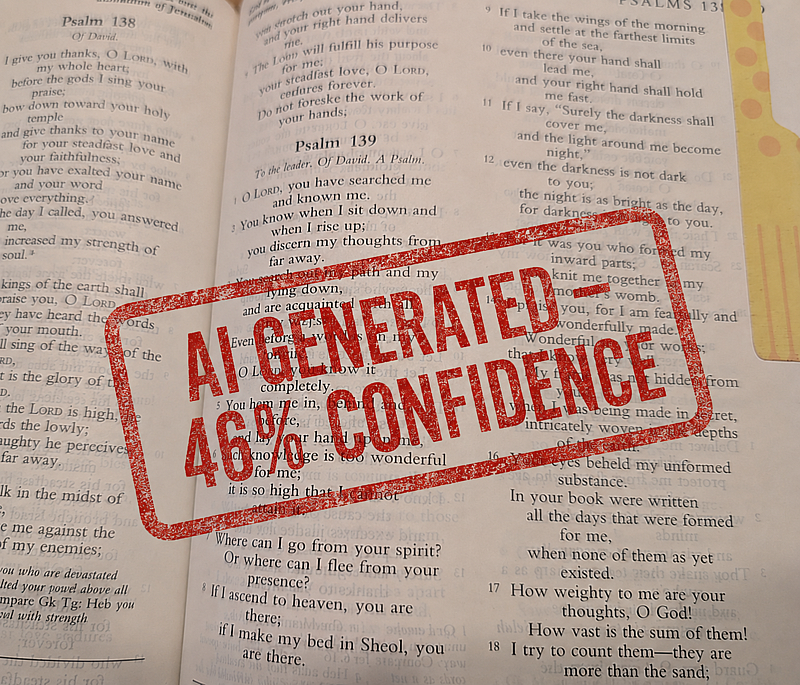
An AI detector just flagged 46% of the Pope’s new encyclical as AI-written.

Filed under: LinkedIn — Tags: , , , — Bryan @ 10:01 pm

An AI detector just flagged 46% of the Pope’s new encyclical as AI-written. The encyclical is about AI ethics. It was written in a prose tradition over a thousand years old. The same detector rated other paragraphs of the same document at essentially 0%. Same author. Same document.

I ran a similar experiment on myself. I asked ChatGPT to review my personal blog from 2008-2017 and identify posts that read as AI-written. It identified 35% of them as having structured arguments, clean frameworks, numbered examples, and tidy conclusions. None of them were AI-assisted. None of them could have been. ChatGPT didn’t exist yet.

The three worst offenders: a 2009 post about Twitter with definitions and numbered use cases. A 2010 business case for mobile websites with data and a strategic conclusion. A 2014 incident postmortem with a failure chain and lessons learned. Those aren’t AI patterns. Those are writing patterns. Humans have been organizing their thoughts like this for centuries.

A year ago these same tools were being sold to help you write more clearly. Now writing clearly is the evidence you used them.

Even the article covering this story hedges: “practitioners should treat single-detector outputs as suggestive and seek multi-method forensic work before drawing firm conclusions.” Here’s a conclusion that doesn’t require forensic work: if a writing tradition predates electricity, maybe weight the patina of the source before you let an algorithm accuse it of being a machine.

#AIDetection #FalsePositive #WritingIsNotACrime #AIEthics #ContentAuthenticity

Today I walked through an empty warehouse, powered down the internet…

Filed under: LinkedIn — Tags: , , , , — Bryan @ 2:31 am

Today I walked through an empty warehouse, powered down the internet connection, collected the last IT equipment for recycling, turned off the lights, and locked the door.

For almost six years, I was often the one to handle the difficult conversations, the one to stop and drop everything to run halfway across the state to handle an emergency because we needed boots on the ground. Terminations, restructuring staff, the meetings nobody wants to be in, a fraction of my work but just as critical as anything else. That just became my job while building out an enterprise grade IT environment for the company (IT that just worked and stayed out of the way). The kind of work that never ends up in a job description, but the kind of work that finds the person willing to do it.

After a few years it became a running joke. If I showed up to a job site unexpected, the first question was “who’s getting let go now?” followed by “Bryan’s going to be the last one here. And if Bryan’s gone, we’re all done anyway.” Polite chuckles. It was always in good fun. I never took it personal and teased them right back.

Every single person I was tasked to let go from the company I tried to do so with as much dignity, respect and empathy as I could provide regardless of the reasons for the termination. Even in rough cases I still reached out and offered my hand in parting.

My time with this company is now past tense. And I was, in fact, the last one out the door. No handshake. No hug. No “you did your best.

If you’ve ever been the person in your org who does the work nobody else wants to do, you already know how this story ends. You don’t get a ceremony. You get an empty building and a set of keys to return.

And you look for the next chance to do the right thing where you can.

#OpenToWork. #Leadership

Older Posts »