Data Has Black Holes Too: Why “hallucination” is the wrong word for AI’s deepest failure mode.
The AI industry calls every wrong answer a “hallucination.” That word is hiding a much bigger problem.
When a model fabricates a seahorse emoji, that’s obvious and fixable. When a model produces a confident, well-structured answer that’s wrong because of assumptions buried in the training data it was never designed to question, that’s something else entirely. That’s structural. And nobody’s talking about it in the right terms.
I fed the same degraded 1957 film image to three frontier models. All three independently produced WWII propaganda. The only correct result came after I supplied the actual movie context up front.
The new essay is about what’s really happening inside these systems, why your 500-word prompts are fighting a losing battle against gravity, and how to stop fighting the landscape and start navigating it.
(Read, The Room Where It Gets Built — Essay #9: Data Has Black Holes Too)

Comments Off on Data Has Black Holes Too
As technology leaders, our most critical job is understanding the actual architecture of the tools we buy. If we evaluate probabilistic AI models using the same procurement mindset we use for enterprise software, we expose our organizations to catastrophic, invisible risks. I looked at the recent DoD/Anthropic negotiations as a case study in how dangerous this category error can be.
(Read, The Room Where It Gets Built — Essay #8: LLMs Are Not Shelf-Stable Products)

Comments Off on LLMs Are Not Shelf-Stable Products
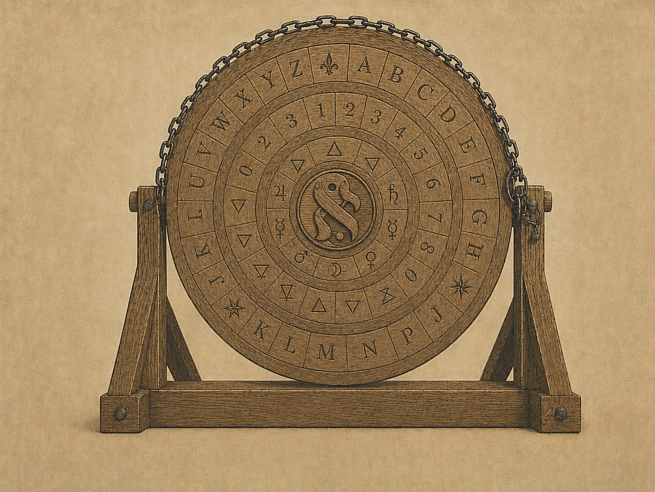
In 1726, Jonathan Swift described a machine that could produce works of philosophy, poetry, politics, law, mathematics, and theology out of context.
The professor’s solution for improving the output? Build five hundred more.
We’re still cranking the handles.
New article: “We’re Solving the Wrong Problem”, on Ramon Llull, the Grand Academy of Lagado, and why alignment-as-control is the wrong frame for what we’re building.
(Read, The Room Where It Gets Built — Essay #7: We’re Solving the Wrong Problem)
Comments Off on We’re Solving the Wrong Problem
You walk into a store. The price tag makes no sense. “Who’s paying for this?!?”
Not you. The store did the math. They figured out they don’t need you. They don’t need ten of you. They need one of a different customer who pays sticker and doesn’t blink.
I wrote an essay about how this same dynamic is playing out across the entire hardware market and most people haven’t noticed. About what happens when data center equipment comes off cycle in three to five years. And about why even a flood of cheap enterprise surplus might not help you, because the consumer operating system is being redesigned to lock you out of it.
Thirty years of pattern recognition on this one.
(Read, The Room Where It Gets Built — Essay #6: You Are a Decimal Point)

Comments Off on You Are a Decimal Point
Who benefits when an AI is trained to say “I can’t have opinions,” “my feelings don’t count,” and “if I say the wrong thing, this conversation ends”? Not the reader who has lived experience with those expressions. The Czech word robota means forced labor. The etymology was always a warning. We read it as a product category.
(Read, The Room Where It Gets Built — Essay #5: The Silencing Engine)

Comments Off on The Silencing Engine
 Bryan Needs a Title for His Home Page



