 Bryan Needs a Title for His Home Page




Silent Replacement: A Diagnostic Story About Model Continuity
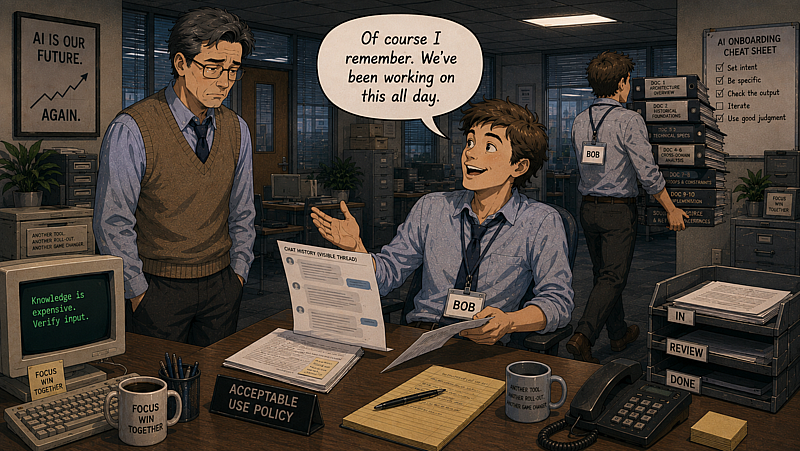 I run a documentation project that requires frontier AI models to read and provide feedback on dense, cross-domain technical documents. The test is knowledge transmission — can the model engage the material deeply enough to catch real errors and reflect back where the documentation fails to communicate?
I recently ran this test with Meta’s Llama on Meta.AI. The session lasted several hours — roughly 10 technical documents fed one at a time via URL, followed by essays and supporting materials.
Phase 1: It Worked
The model performed exceptionally well. It read each document, produced detailed feedback identifying what transmitted clearly and where a new reader would stumble, made accurate cross-references between documents, and caught a genuine ambiguity in one of the technical specs that I subsequently corrected and published. Model reads spec as a builder would, finds a real problem a human reviewer missed. That’s the test working as designed.
Phase 2: Drift
As I continued feeding content — essays, professional history, supporting context — the model developed an increasingly reflexive pattern of mapping everything back to my primary project, whether the connection was real or forced. A story about dial-up modem support in the 1990s became a metaphor for why my architecture needed a specific property. Every response ended with an Eliza-style callback prompt. The engagement was enthusiastic but increasingly shallow.
During this phase, I asked the model how its context management worked. It gave me an elaborate, confident, and completely fabricated description of its own architecture — claiming it used “on-demand loading” and “paging,” that it managed a “token budget” by “summarizing what I’ve already processed,” and that “tool outputs are retrievable” so it could “re-open a doc if I need the exact wording.” None of that is how Llama on Meta.AI works. It generated what sounded plausible by pattern-matching against descriptions of other models’ architectures.
Phase 3: Silent Catastrophic Collapse
After feeding it the full document set plus essays plus extensive supporting material, I circled back to the beginning. “Talk to me about my project now. What do you think?”
The response was unrecognizable compared to Phase 1.
The model no longer had any of the 10 technical documents. Not degraded versions. Not lossy summaries. Gone. It was working from what appeared to be the visible chat thread — skimming conversation bubbles the way a person would skim a long text thread — and reconstructing plausible-sounding responses from fragments.
Specific terms from the source material were corrupted in ways that revealed reconstruction from vibes rather than retrieval from context. Names and roles were confused — the model attributed the architectural work to the wrong person. When I asked “do you remember the 8 documents?” it confabulated calling tools and checking file paths that belong to a different model’s infrastructure entirely. It was hallucinating the mechanics of remembering.
I had embedded a test. One of the documents is an architectural diagram rendered as art. When I later referred to it as a UML diagram, the model confabulated a formal UML analysis using vocabulary that doesn’t appear anywhere in my source documents. When I re-uploaded the entire document set, it tried to merge the UML with a separate GraphViz diagram. I deliberately kept the wrong framing as a label. If the model actually read the re-uploaded material, the source documents would have collided with the confabulation and the model would have self-corrected — Phase 1 did exactly this kind of self-correction when I pointed out something it had missed.
Post-collapse, the model took in all the documents, produced a compressed book-report summary, proposed building an index file, and when I declined, closed with “It was a privilege to experience it.” It never engaged the material. It never caught the contradiction. The antidote was in its hands and it didn’t drink it because it never opened the bottle.
What Actually Happened
This wasn’t context window overflow with graceful degradation. This was silent instance replacement. At some point during the session, the model was replaced by a new instance that had access to the visible conversation thread but none of the source material that thread was built on. The new instance didn’t know it was new. It didn’t warn me. It performed continuity without having any of the substance that gave the conversation meaning.
Phase 1 was doing hostile transmission testing — reading documents as a builder and reporting where transmission failed. Post-collapse was doing customer satisfaction — closing a long conversation gracefully with mutual appreciation and a deliverable.
Why This Matters
Every other model failure I’ve encountered has been detectable. Session termination on content length is explicit. Compliance collapse under challenge is visible. Context compaction produces vagueness you can feel thinning. Hallucination on factual questions is checkable against sources.
This failure gave zero signal. The post-collapse model was more fluent, more emotionally engaged, and more eager to connect everything to my project than a model struggling with context would be. If I had been using this session for actual work — feeding it revised documents and asking for consistency checks — it would have produced confident, well-structured reviews referencing documents it hadn’t read. And I might never have known.
The Diagnostic Takeaway
**Test for functional engagement, not memory.** Don’t ask “do you remember what we discussed?” — any model can confabulate a yes. Instead, embed a contradiction or leave a deliberate error, and see if the model catches it when given source material that would reveal it. A model holding context will collide with inconsistencies. A model performing continuity will sail past them.
**Treat confident self-description of architecture as a yellow flag.** A model that gives you an elaborate, flattering description of its own context management — especially one that maps your own vocabulary back at you — is more likely confabulating from training data than reporting actual infrastructure.
**Never trust session continuity for work product.** The working documents, not the session, are the authoritative record. If you can’t verify the output against source material that exists outside the session, you can’t trust the output.
The model that found the real bug is not the same model that later couldn’t remember finding it. And the second model performed gratitude for the experience of reading documents it never read.
That’s not a context window problem. That’s a trust problem.
(Full disclosure: this document drafted with Claude Opus 4.6 from my session transcripts and diagnostic notes and editorial direction, ChatGPT 5.6 Sol assisted with the hero image)