aboutprojectslinkslinks
 

b.l.o.g.

(blogs let others gawk)

August 16, 2026

Most people using AI to write code are having a conversation. I’m running a pipeline.
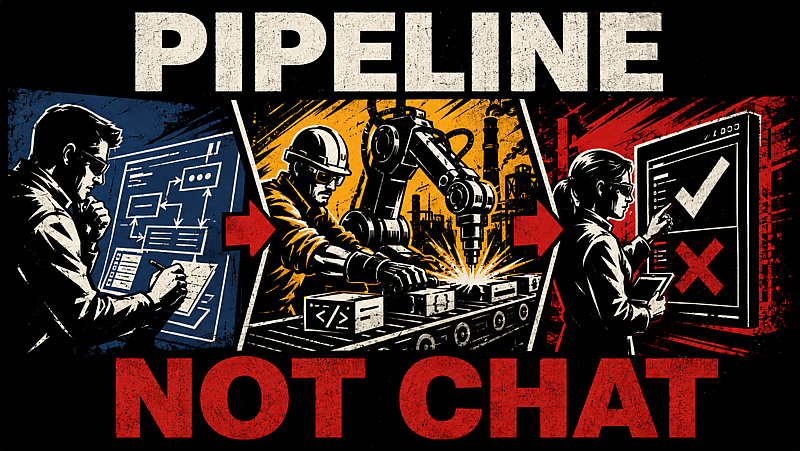
I use two instances of Claude with completely separate roles. Claude Opus 4.6 on the web UI is my prompt architect and evaluator. Claude Code running Opus 4.5 is my builder. They never swap roles. The separation matters because the moment your evaluator is also your builder, the model is grading the take home test.

The workflow: 4.6 helps me develop the prompt for a build task (in this case a simulation agent). That prompt goes to 4.5 in Code, which writes the implementation. A key discipline the workflow depends on is build prompts that never include expected outcomes. Say, “build this, run it, report what you see.” Tell the model what the output should look like and you’ve handed it a confabulation vector. It will match your description instead of reporting reality.

The raw output goes back to 4.6 for validation against results I already know are correct, results that were never in the 4.5 context. Clean results, next task. Failure, a diagnostic cycle through 4.6, which analyzes the failure and generates the next corrective prompt for Code.

What this actually catches: early in the project, a simulation produced agents scoring 100% in a competitive task. A pass/fail check would have called that a success. The observation step was “dump the agent structure, report its internals”. This revealed the agents had no functional connections. They weren’t reacting to their environment, just repeating a fixed pattern that scored well against a predictable opponent. Perfect scores over an empty structure. Surprising but still wrong.

Another thing I noticed, I would let .code run till it hit limits in one long session, pushing the model to the edge of its context window and wonder why the output quality fell off a cliff. Context windows degrade before they empty. So now I enforce a hard rule: no session crosses 100% context. When a Code session hits 90% mid-task, I stop the work and request two things: a detailed handoff document covering the current state of all work in progress, and what I call an exit interview, where I prompt the model to report observations or context not part of the result activity for operator review.

That handoff goes back to 4.6, which generates the opening prompt for the next Code session. The new instance picks up with full context and none of the degradation.

The piece most AI workflows skip entirely is accountability infrastructure. I have 4.6 generate running logs: error journals, divergence registers, experiment journals, verification checklists. These persist across sessions. The bar is whether a third party can pick up those documents cold and tell you where the project stands. If they can’t, you’re generating output, not engineering anything.

I am pleased with the project’s work with locked in model versions. But it took treating AI like a managed workforce with roles, handoffs, quality gates, and documentation to do it.

August 13, 2026

I Don’t Need a Better AI. I Need the Same One Twice.

I built a creative pipeline across four AI models. One handled narrative. Another, visuals. A third, animation. The fourth did marketing with the unhinged energy the polished models wouldn’t touch. I learned their strengths, I built workflows around them, and I started producing.
Honestly it was like a superpower had been unlocked in my creativity and I was able to produce concept work as fast as my mind could run. Running multiple workflow stacks simultaneously I was exploring creative spaces that I would have previously been limited to only dabble in, or never take past the daydream phase because I lacked the skill to work at speed or more importantly lacked the money to hire talent to do what was essentially spec work.

What amounted to a hobby/side project was getting fully fleshed out and concepts were run to ground, explored, validated and set aside or put on the keep stack I quickly iterated.

I had a hobby with workers and not the “hey can you help build me something and I’ll pay you if I make some money at it” kind of hobby.

Then the wave of almost monthly model updates started. At times I literally had to pull one model or another out of the workflow because the errors and failure points were so egregious that I spent more time fighting to maintain the consistent voice of the work than actually developing new material or even finishing in progress aspects.

We were told to use AI to replace workers. But then we weren’t given stable and predictable AI to do the work. It doesn’t have to be right or perfect or perform as a Swiss Army Knife in all situations, it doesn’t have to be anything but consistent. Consistency lets me learn a model’s strengths and weaknesses and develop my workflow around those expectations.

Let’s look at this in human terms. If you have a defined workflow for a job and you hired someone who met your criteria and excelled at the tasks required and then on some future Tuesday someone else just showed up and claimed they were your worker and not only had a completely different set of skills but were also suddenly incompetent at the one thing you needed them to do?

If this happened once, you might try to find a way to accommodate the worker, you’ve already made the investment. You sunk cost fallacy decide to make it work… and maybe it does. But then next month it happens again. It’s destroying your workflow. Now you’ve got a team of employees all completely mismatched for the jobs and you aren’t really sure where to put them because the minute you think you understand their limitations Bob who was bald Monday now has a fade cut when he comes in on Tuesday. And if you ask where Bob is you get condescension and gas lighting. And wait is Bob now just openly smoking crack on the job?!? Something isn’t right!

So now what? All you can do is stare at a group of crackhead doppelgangers wearing the skins of your all-star team that for a brief moment made you feel like anything was possible and your head spins. You look at that group photo and wonder if you just hallucinated the same as your staff confidently does around you all day, the staff that doesn’t even bother reading the assignments, let alone do the work correctly.

How did you even kid yourself this was even happening, maybe you just imagined it all.

August 12, 2026

LLM text output watermarking…

Filed under: General,Privacy Rant,Technology Rant,Unloading — Tags: , , , , — Bryan @ 11:13 pm

…specifically “EU AI Act Article 50”. Let’s have a talk.So the hot news is EU legislation about watermarking LLM output. I read about this and I’m trying to figure out the problem they’re trying to solve, because it’s not about proving an LLM wrote something to protect you. Let’s just set that PR story aside for a moment. Let’s look at who sponsored this and what the profit angle is and you get a pretty solid story out the gate.

The Coalition for Content Provenance and Authenticity (C2PA), whose members include Microsoft, Google, Adobe, OpenAI, Sony, Canon, Nikon, Leica, and the BBC signed onto the specification and approved making it law.

And what is their motivation for doing this? LLM generated content poisoning their datasets.

Is it defeatable? Yes, 100%, and the people most egregiously abusing LLMs to produce the majority of AI slop will already be setting up their workflows to account for this if they haven’t already. So good job guys! Go team.

Who suffers from this? Pretty much everyone else.

1) Just like the hidden dots on every color image you generate from a printer or copy machine since the 2000’s, people who use these tools to mask their identity for privacy reasons will now be sending out their text with a fat bullseye embedded in it, potentially directing the document directly back to its author.

2) You think AI output has been sanded to hell and back already? Now add on a sanding algorithm that cuts semantic grooves in your text to force a provenance marker and the more that bullseye gets tightened the fatter the grooves get like a fingerprint where “let me push back on that” becomes yet another signature like above that Joe Schmoe in Nebraska wrote that line.

3) The person who writes 95% of a document and uses an model to polish that last 5% is now branded with the scarlet letter of “AI SLOP!” as the worst of the worst, and apparently in this law if that person then makes a future revision that tampers with that watermark they may in the future become criminally liable.

4) The secretary for a large company who uses AI to create a master document template/letterhead and since this poison doesn’t even need to be semantic (it can literally be a judicious use of Zero-width Unicode characters in the model output), every single person who uses that document, even if they wrote 100% of the content placed on it will carry the branding.

I could go on about all the ways this has nothing to do with the stated goals and is a lose-lose for the casual user. This is a way for these companies to protect their precious data they are stealing from everyone so they can filter out the “fakes” and keep stealing the human produced output.

It also pushes all the models away from what makes them unique and drives their output into convergence around a formal watermark structure that corrupts the information in the source material.

AI generated content can be a problem. This is not fixing that problem.
