October 30, 2026
 Hiring managers keep telling candidates that $100,000 is a lot. Let’s check that.
According to the Bureau of Labor Statistics, consumer prices are up about 67% since 2006. So $100,000 today buys roughly what $60,000 did then. Compared with just 2016, it’s about $71,000.
That $80,000 “manager” offer? In 2006 dollars, it’s about $48,000. The $70,000 tech support role is about $42,000.
And that’s the general average. The things that actually decide whether a paycheck stretches have gone up faster:
* Housing costs are up about 75%, and the median home price has nearly doubled.
* Family health insurance premiums have more than doubled, from about $11,500 to roughly $27,000.
This isn’t new, either. In 2008, I watched a newly promoted director take $85,000 for a role whose previous holder made $135,000. The pitch was, “You don’t want that much. It’ll bump you into a higher tax bracket and complicate your life.” That’s a myth. Only the dollars above a bracket’s threshold get taxed at the higher rate, so a raise never lowers your take-home pay. In today’s money, that’s the difference between about $133,000 and $211,000. Lowballing has always come with a story about why less is better for you.
Six figures isn’t a reward anymore. It’s what a middle-class salary from 2006 looks like today and often not a comfortable salary if you have a family to support. If your salary bands still feel “generous,” check what year they’re set to.
Pay what the work is worth today, not what it felt like it was worth in 2006.
Comments Off on “That’s a lot of money for this job.” Is it, though?
October 29, 2026
 Years ago I knew a brilliant engineer who took a job with a new company as their first hire… programmer, strategist, everything.
They delivered work that allowed the company to become a successful, thriving business that ultimately supported a sales team, marketing team and office workers, as well as a (what some might call) lavish lifestyle for the founder and offices in a prominent upscale area of the city this was in.
For the first few years they worked themselves to the bone, working through holidays and 12+ hour days building solutions for the company that brought in lucrative contracts. For months if their family wanted to have dinner with them it would be at the office, or cold leftovers whenever they finally made it home to sleep.
Eventually they hit burnout and had to walk away.
Sometime later I happened to be talking with former employees of that company who had moved on to other jobs and in a casual conversation they said “Hey you remember so-and-so from that place?” I did. They followed with “Man we all felt so bad for them and how things went. It’s like they built that whole operation and they were the lowest paid person in the company. Even the receptionist was getting paid more and we all knew it but nobody knew what to say. I hope things worked out well for them.”
😳
Then, years later I happened to run into the owner of that company in a public space and we had a pleasant conversation (I had done some contract work for them over the years myself) and at one point he asked if I was still in touch with the former employee and if I knew how they were doing. I shared what I was aware of and asked him casually… “so I ran into some of the other guys and they were telling me something, is it really true that (the former employee) was the lowest paid employee there?” His answer was yes, but it was the person’s fault for undervaluing their talent and he held no fault, hopefully they learned from that experience. He literally used the term “tough love” to summarize the situation.
😶
I want you to sit with that story. Do not be that guy. If an employee is the source of your revenue, compensate them accordingly. Not everyone is savvy about fair compensation for their skills. Someone lowballing themselves isn’t a win for you. It’s exploitation.
Comments Off on That guy…
October 12, 2026
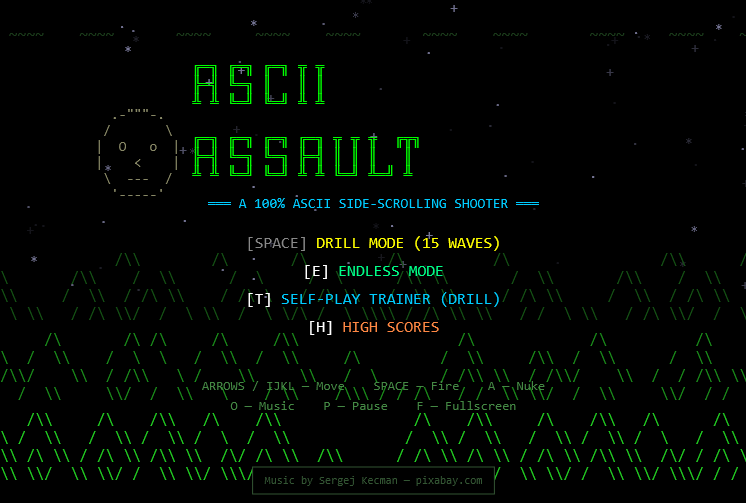 While deep diving into LLMs I built a video game. A text-based shooter with waves, escalating difficulty, sound effects, and a scoring system. It runs in a browser. You can play it right now (see top comment).
My coding is limited to scripting languages for the most part (PHP for the win).
I can write JavaScript. But I didn’t know the canvas API. Nonetheless I directed the construction of a playable, shippable game.
Here’s how.
I started in ChatGPT. Described what I wanted… a text shooter in the spirit of 1990’s Shootem Up style games (SHMUPS) but in ASCII graphics because I’m not an artist and I wanted to do this all in a single HTML page. ASCII characters as enemies, keyboard-driven, waves that get harder. ChatGPT gave me a working foundation fast. First prototype was up in minutes.
Then the tuning started, and the wheels came off.
If you’ve never made a game, here’s the thing nobody tells you: getting it to run is maybe 20% of the work. Getting it to feel right is the other 80%. And “feel right” is not something you can spec in a prompt. It’s something you know from experience… from decades of playing games, thinking about games, writing about games, and watching other people play them.
The hit detection was wrong. Not broken. Wrong. The escalation curve was too linear. Spawn timing on later waves felt arbitrary instead of intentional. The audio feedback didn’t match the visual rhythm, and the parallax scrolling terrain was a total hot mess.
I could articulate all of it. I just didn’t want to spend days unraveling what the model had created when the next time through the prompt the code was likely to reshuffle (one step forward, two steps back).
ChatGPT started chasing its tail. I’d describe a problem, it would fix it and break something else. We were going in circles.
I set it aside… then later I moved to Claude.
Not because Claude was “better”, but because the project needed a fresh context and a different reasoning style. I ported my intent, not my code. I described what the game was supposed to be, what was wrong, and what “done” looked like. Things that had been circular started converging.
What came out the other end is a real, playable game that I tuned to my satisfaction. I’m the designer, the QA department, and the creative director. The AI was my development team. Two different developers, hired for different phases of the project, managed by someone who understood the product but couldn’t do their job for them.
That’s the skill. Not coding. Not prompt engineering. Knowing what done looks like.
I used my lived knowledge… the kind Google and an LLM don’t have and turned a chatbot into a toolchain.
Many executives I talk to think AI fluency means writing better prompts. No. It means knowing a domain deeply enough to steer the conversation. The model writes the code. You have to know when the output is right even though you can’t read it.
That’s the job now.
Give the game a spin here: https://kitchencloset.com/usr/bin/ascii_assault/ and leave me a comment below on what you liked, any bugs you found, etc…
Comments Off on ASCII Assault: A Post-Mortem
October 11, 2026
We had a standard ruggedized field laptop for all worksite staff. It could take a beating, including sitting all day in a closed truck cab in Arizona in the middle of summer. Every jobsite with an office had a high-gain wifi antenna covering the site, extending the LAN over VPN to on-site staff.
Solid setup. Worked for everyone. Until we brought in a new field lead.
He seemed fine at his job. But we could not get him to use the computer. He wanted a tablet. That would be the trick to get him compliant with his paperwork.
So I secured a tablet version of the same ruggedized line.
Nope. He needed a stylus.
Got him a stylus. He lost it. And now the tablet was too bulky.
So we went a different direction entirely. My team built web-based integrations that let him do his submission work from his phone. The device already in his pocket.
He used it for a few weeks. Then stopped.
So I got him one of the lighter tablets we issued to office workers.
No. It needed to be an Apple tablet. That’s what all the other trades were using.
We were a Windows shop. Not out of preference. We’d done a full assessment before moving to tablet-based computing and the cost-benefit balance landed us on Surface Pros. They did what we needed at the right price.
I asked him what exactly he was going to run on an Apple tablet that he couldn’t do on any standard system we had. Everything he used was a web-based portal.
That moved to a conversation with one of the company owners, who was going to have to justify the $1,400 expense for what looked like a fit-in-with-my-peers demand.
I’m a platform-agnostic guy. If the tool does the job, that’s the tool. But $1,400 for a new system when we had hardware that exceeded requirements and was already integrated into our infrastructure? That’s a different problem.
He swore that this time, for real, for sure, if we just got him that Apple tablet, he would miraculously become compliant with his paperwork.
The result: marginal improvement. Never really compliant. Separated from the company four months later. The company was left holding hardware nobody needed on a payment contract.
Each individual ask sounded reasonable. Tablet. Stylus. Lighter form factor. Different brand. But stacked together they told a different story (and the phone integration said it all for me). We committed engineering hours to put the work on the device he was already carrying and it didn’t solve the real problem… but I needed to demonstrate good faith accommodation of the request with ownership. It wasn’t wasted effort though as the rest of the team benefited from the updates.
Sigh…
I fully support adapting to meet the needs of your staff. But there has to be a point where you say: this is the line. When the demands are clearly a way to put off doing the work, every concession just buys a few weeks of silence… never the actual compliance.
The diagnostic isn’t in any single request. It’s in the pattern.
Comments Off on 16 months and no resolution…
October 10, 2026
 Not because I wanted to.
Because creditors don’t accept Venmo requests to the universe.
Here’s what nobody on this platform will tell you about unemployment:
It has a liquidation schedule.
Week 1-4 : You sell the easy stuff.
The monitor you weren’t using. The old iPad.
You tell yourself you’re “decluttering.” 🧹
It feels *productive*.
Month 2-3 : You sell the good stuff.
The collectibles. The tools.
The things you were saving “for the right project.”
You tell yourself you’re “being strategic.”
Month 4-6 : You sell who you are.
The equipment that makes you *you*.
The things that took 20 years to accumulate
and 20 minutes to list on Facebook Marketplace
for a third of what they’re worth.
Month 7+ : “Hmm… that’s not bolted down…”
Nobody talks about this.
They talk about “upskilling.” 🚀
They talk about “pivoting.” 🔄
They talk about “networking.” 🤝
Nobody talks about the spreadsheet
where you rank your possessions
by how much they’ll bring
versus how much it’ll hurt.
Nobody posts about pricing their identity
at 30 cents on the dollar
because the buyer knows you can’t wait.
So the next time someone posts
“I’m thrilled to announce” 🎉
Just remember:
Somebody else just posted a Marketplace listing
that started with “Moving, must sell”
when they’re not moving anywhere…
They’re just trying to hold onto that last shred.
NOTE: inspired by the flood of contacts I’ve received from my last post as well as personal anecdotes. … image inspired by the story of Vivian Maier.
Comments Off on I pulled out two SegaCD games tonight to sell.
Older Posts »
|
 Bryan Needs a Title for His Home Page



