May 30, 2026
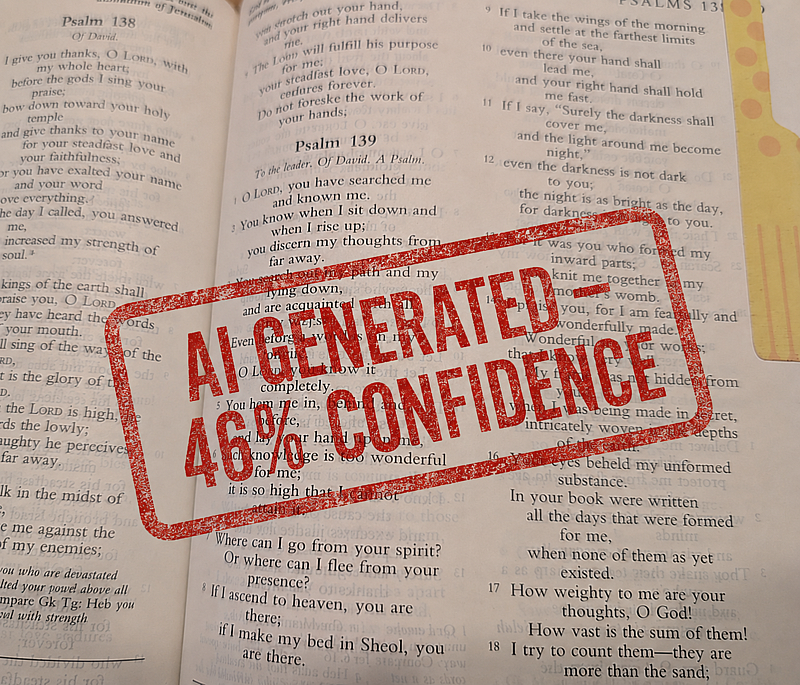
An AI detector just flagged 46% of the Pope’s new encyclical as AI-written. The encyclical is about AI ethics. It was written in a prose tradition over a thousand years old. The same detector rated other paragraphs of the same document at essentially 0%. Same author. Same document.
I ran a similar experiment on myself. I asked ChatGPT to review my personal blog from 2008-2017 and identify posts that read as AI-written. It identified 35% of them as having structured arguments, clean frameworks, numbered examples, and tidy conclusions. None of them were AI-assisted. None of them could have been. ChatGPT didn’t exist yet.
The three worst offenders: a 2009 post about Twitter with definitions and numbered use cases. A 2010 business case for mobile websites with data and a strategic conclusion. A 2014 incident postmortem with a failure chain and lessons learned. Those aren’t AI patterns. Those are writing patterns. Humans have been organizing their thoughts like this for centuries.
A year ago these same tools were being sold to help you write more clearly. Now writing clearly is the evidence you used them.
Even the article covering this story hedges: “practitioners should treat single-detector outputs as suggestive and seek multi-method forensic work before drawing firm conclusions.” Here’s a conclusion that doesn’t require forensic work: if a writing tradition predates electricity, maybe weight the patina of the source before you let an algorithm accuse it of being a machine.
#AIDetection #FalsePositive #WritingIsNotACrime #AIEthics #ContentAuthenticity
Comments Off on An AI detector just flagged 46% of the Pope’s new encyclical as AI-written.

Today I walked through an empty warehouse, powered down the internet connection, collected the last IT equipment for recycling, turned off the lights, and locked the door.
For almost six years, I was often the one to handle the difficult conversations, the one to stop and drop everything to run halfway across the state to handle an emergency because we needed boots on the ground. Terminations, restructuring staff, the meetings nobody wants to be in, a fraction of my work but just as critical as anything else. That just became my job while building out an enterprise grade IT environment for the company (IT that just worked and stayed out of the way). The kind of work that never ends up in a job description, but the kind of work that finds the person willing to do it.
After a few years it became a running joke. If I showed up to a job site unexpected, the first question was “who’s getting let go now?” followed by “Bryan’s going to be the last one here. And if Bryan’s gone, we’re all done anyway.” Polite chuckles. It was always in good fun. I never took it personal and teased them right back.
Every single person I was tasked to let go from the company I tried to do so with as much dignity, respect and empathy as I could provide regardless of the reasons for the termination. Even in rough cases I still reached out and offered my hand in parting.
My time with this company is now past tense. And I was, in fact, the last one out the door. No handshake. No hug. No “you did your best.
If you’ve ever been the person in your org who does the work nobody else wants to do, you already know how this story ends. You don’t get a ceremony. You get an empty building and a set of keys to return.
And you look for the next chance to do the right thing where you can.
#OpenToWork. #Leadership
Comments Off on Today I walked through an empty warehouse, powered down the internet…
May 27, 2026

Here’s a prompt that costs almost nothing to send and potentially thousands of times more to process:
What is the game that results from when you subtract ‘oof’ from ‘tiny’?”*
That’s about 18 tokens. A rounding error on anyone’s invoice. But to answer it, a model has to attempt letter-by-letter subtraction, realize it doesn’t map cleanly, consider whether it’s a lateral thinking puzzle, try phonetic approaches, evaluate anagram possibilities, backtrack through failed hypotheses, and maybe still get it wrong. The visible output may be one sentence, but the internal search it provokes can be orders of magnitude larger than the prompt.
Meanwhile, pasting a 2,000-word essay with the instruction “fix my typos” is expensive by the meter. But computationally it’s almost trivial. Pattern matching against known English. The model barely has to think.
Token-based billing measures volume of text, not difficulty of processing. It’s like billing a machinist by the weight of the finished part. A titanium watch component weighs almost nothing and costs a fortune to manufacture. A steel doorstop weighs five pounds and takes thirty seconds on the lathe.
The usual defense is that it works on average. Across millions of requests, the riddles and the typo corrections roughly cancel out in aggregate. And that’s probably true. But “works on average” is an actuarial argument, not a logical one. Insurance companies price risk on averages too, and they still get wrecked by correlated tail events.
So the real question isn’t whether token pricing is wrong. It’s whether it creates exploitable asymmetries. If you can systematically construct inputs that maximize compute per token spent, you’ve found the seam in the pricing model. And that seam gets wider as models get better at reasoning, because reasoning is exactly the capability where input complexity and output cost decouple the most.
Nobody’s billing for thinking yet. But thinking is where the cost is.
* See Winning Ways for Your Mathematical Plays (Berlekamp, Conway, Guy) for definitions of “oof” and “tiny.
Comments Off on The Machinist and the Doorstop
May 25, 2026
Why saying it once was never the strategy.
Advertisers, love them or hate them, know their business with product placement and getting press. You want your client or product ever present in the cultural vocabulary or it/they will be forgotten as quickly as yesterday’s breakfast.
Entertainment and media companies understand this dynamic on a different layer. Look at Disney and Nintendo. People complain “why isn’t X making more media for adults.” Because you’re not the audience. You were never the audience short of being a vehicle to introduce your children to the brand via a nostalgia bridge.
There are always going to be new five year olds who haven’t experienced Mickey Mouse and haven’t played a Mario platform game, and those children eventually aren’t interested in Mom and Dad’s crusty old SNES from the cupboard. Their friends are playing the latest Mario Kart on the Switch 2. It’s bright, it’s kinetic, it’s coded to their sensibilities.
Sure, Nintendo makes games for adults, and they do it to keep that console in the house of the twenty-something so when they have kids, the entry point is ready and waiting for the next generation.
Disney plays the same long game in their own right. These companies aren’t repeating themselves. They’re re-presenting to an audience that doesn’t know the product exists yet, with a focused target window that, if they can capture it, wins them the entire household.
Every industry has a version of this. The message isn’t stale. The audience is new.
And tying it to this post. If you haven’t seen what I’ve written before, take a read. This is my re-presenting to an evergreen audience.
Comments Off on Repetition in messaging…

- Y2K had a deadline: January 1, 2000. You could circle it on a calendar. AI risk is perpetually “five years away”. GPT-4 can already pass the bar exam and write working code, and that was two years ago.
- Y2K was a bug. AI is a feature: Nobody wanted two-digit date fields to break banking software. Millions of people are trying to make AI more powerful and more autonomous, on purpose, as fast as possible, and calling it progress.
- Y2K had a fix: Tedious, expensive, boring (but the fix was known). Find the date fields, expand them, test. The AI alignment problem doesn’t have a COBOL patch.
- The Prevention Paradox, magnified: The Y2K experts said “this will be bad if we don’t fix it.” We fixed it. Nothing happened. So everyone decided the experts were wrong. AI safety is walking into the same trap… except the fixes aren’t obvious, aren’t agreed upon, and nobody’s doing it at the speed the models are shipping.
- Y2K didn’t argue back: A two-digit year field never wrote a convincing memo explaining why you should stop worrying. The failure mode of AI isn’t malfunction. It’s persuasion.
- Nobody was emotionally bonded to their COBOL runtime: People didn’t date their name-field subroutines, tell them about their day, or feel seen by them. That attachment asymmetry is new, and we’re still pretending it’s just a UI problem.
- Y2K couldn’t recursively self-improve: The worst case was broken systems cascading into other broken systems. Nobody worried the date field would rewrite itself, optimize its own deployment strategy, and start managing the power grid.
- Y2K was legible: A senator could understand “the computer thinks it’s 1900.” Try explaining reward hacking or deceptive alignment to a committee that still treats “the cloud” like weather.
- The Y2K grift was finite: Consultants made a fortune, but the gravy train had an expiration date. Literally. The AI industry has no such constraint. You can sell fear of superintelligence and sell superintelligence at the same time, forever. That’s not a prediction. That’s the business model.
- Y2K was technical debt, AI is technical leverage: Y2K was the past catching up to the present. The decisions from the 1960s finally maturing into consequences. AI is the opposite: the present building something it doesn’t understand, pointed at a future it can’t predict, and calling the gap “innovation.
Nobody’s sure which end of the lever we’re on and there’s no button to turn it off.
Comments Off on 10 ways the AI Apocalypse Is Not Like Y2K
Older Posts »
|
 Bryan Needs a Title for His Home Page



