aboutprojectslinkslinks
 

b.l.o.g.

(blogs let others gawk)

July 14, 2010

The industy is dead! Long live the industry! (Won’t someone think of the children!?!)

Since I touched on the subject of media transition touched on briefly in my post about going mobile friendly, I think this is a good chance to highlight some historical hysteria regarding entrenched business models collapsing to be replaced by new ones.

Let’s specifically look at the history of music distribution over the last 100 years.

Going into the 1900′s piano rolls and sheet music were the predominant methods of music distribution. Granted there were also broadsides, but those were considered a medium for the working class and were typically lyric sheets with no music score, commonly notated with statements like ” sung to the tune of -fill in the blank- “.

Even in a time where the average worker earned around $600 a year, 25-60 cents for a copy of sheet music was a premium purchase for many. That said, sheet music was big business and when the phonograph came around, sheet music publishers saw the new medium as a threat and fought tooth and nail to kill the medium. “Oh! We can’t let this happen”, “This will destroy the traditional family gathering in song”, “nobody will learn to play music”, “someone think of the children”, etc…

But, the reality on the ground was that pianos are expensive both to purchase and maintain. On the other hand, phonographs are cheaper to produce, cheaper to maintain, easier to operate and you didn’t have to be able to play music to enjoy them. In the end music producers actually sold more copies of music because they now had a larger audience and the companies that adopted to the new business model profited greatly.

Most sheet music publishers failed to adopt the medium hardly failed to die. Granted some of the fears were well founded, the days of the families gathering around a piano to sing together for leisure were lost (if they truly were all that common to begin with). But sheet music is still produced and sold in most music stores. Granted these days it’s mostly piano and guitar based, but, those are the popular instruments for people learning to play music so it only makes sense.

Let’s roll ahead to the next big jump to radio. When radio hit the scene phonograph publishers went crazy. “Oh! We can’t let this happen”, “People will quit buying music when then can get it for free over the radio”, “This will make it impossible for musicians (sic, publishers) to get paid for their work”, etc…

On the contrary to most concerns, radio actually increased sales for two reasons. People were exposed to a larger variety of music and they like the convenience of listing to a song on-demand so naturally they went out to buy their favorite songs in order to have them available to listen to. Publishers that added value to their product saw even better profits (e.g., B-Sides) among core fans.

Then over then next 60 years not much changed aside from improvements in recording and distribution. Granted there were fights over the introduction of cassette tapes and fears that people would just copy music instead of buying it. The same thing happened with CD based music. But don’t forget it’s always been a steady lowering of the bar of the cost of entry into the world of listening to music contrasted against the publishers desires to maximize profits from that same music. Also, people on the whole will more often than not pay for something when they feel it is being sold at a value they perceive as fair. Don’t believe me? Ask Trent Reznor (of the band Nine Inch Nail) or for another example in a different entertainment industry, ask the video game publisher Stardock. Both have spoken out at length about the success of this business model to their sales.

Since the who knows how long the common perception (supported by much anecdotal evidence and statements from artists) is that artists get paid little if nothing for their work when they publish music through a publisher and that publishers takes all of the profit from sales. The big money for the artists more often than not is in concerts and live performances and endorsements. A popular song will generate larger ticket sales and everyone wins (hopefully). This situation set the scale for next big crisis for publishers. The Internet combined with the modern computer.

In the mid-to-late 90′s the barrier of cost related to copying and sharing music finally broke down and anyone with a computer and internet connection suddenly found a plethora of methods to acquire music to listen for free (sometimes pirated, sometimes not) that weren’t available before. And the net result? Sales increased! What’s that? That doesn’t make any sense. The music publishers told us that people stealing music was loosing them money. Wrong. People downloading music was gaining them customers. The money they were supposedly loosing was based on estimates of “if every single downloaded song on the Internet had instead been purchased we would have profited this much”.

… publishers used the same logic with radio by the way.

The reality was that people who used to be pigeonholed to a particular music style suddenly had a inexpensive way to explore new music that they might not have been willing to pay for (on the risk that they might not like it). When they discovered a new artists or new genre they enjoyed, they then frequently went down to the record store to find more of that music to purchase. You had punk rockers buy classical music and country lovers buying speed metal.

But the industry could only focus on the “lost sales” not factoring in that these weren’t really lost sales. Anecdotal evidence from the time indicates that were more like samples. To compare, yes, we know there is always going to be the guy who lives off samples at the grocery store for dinner, but most people actually buy their food and the samples are good because they primarily encourage regular customers to try things they never tried before. The guy living off of them is a cost of business.

I always said at the time that music companies should have jumped on this immediately and put their entire catalogs online at 56kbps bit-rate (radio quality), with an easy click to purchase the higher quality version priced as a convenience item. They would have made a killing, but instead they decided to fight their customers (and still do). Effectively deciding to sue anyone who eats a square of cheese at the deli counter without buying the whole wedge.

When asked years later why they pursued this course of action, one executive answered that they were so scared of the changes happening and knew that they didn’t have a clue about what was going on that they feared everyone was out to rob them and that even the consultants couldn’t be trusted. So they fell back on the only tool they could trust, their lawyers.

Sadly this fight is still playing out even to this day but in the last year some significant changes have happened that probably mark the end for some of the large publishers in this space. The barrier of entry for recording equipment has vanished and a lot of bands, frustrated with publishers and finding greater profitability by simply going solo on the Internet is increasing. When you strip away all of the fluff YouTube is now the largest publisher of music on the Internet at this time. So large that other publishers now effectively turn their content over to them just to get exposure for their artists.

The more things change the more they stay the same. Business is always evolving and those that learn and adopt quickly are well positioned to profit from their observation skills. Others are destined to dig in their heels and ultimately become a footnote to history.

….some references that helped in the creation of this article are listed below.

  • Media-Morphosis: How the Internet Will Devour, Transform, or Destroy Your Favorite Medium: http://www.internetevolution.com/document.asp?doc_id=171555&
  • http://www.econlib.org/library/Enc1/WagesandWorkingConditions.html
  • http://www.bls.gov/opub/cwc/cm20030124ar03p1.htm
  • Perspective: Radio/photograph was going to destroy print: http://web.mit.edu/comm-forum/papers/murphy.html
  • Sheetmusic and broadsides…: http://popmusic.mtsu.edu/dbtw-wpd/textbase/broad/broadside_ex.htm and http://www.phonobooks.com/BirthRec.htm
  • http://cultureandcommunication.org/deadmedia/index.php/The_Victrola
  • Radio was going to destroy the records: http://en.wikipedia.org/wiki/History_of_radio#Legal_issues_with_radio (although the Internet distributed music has revolutionized the way records are sold, it still hasn’t destroyed them)

April 8, 2010

The case for a mobile friendly website

In 2007, it was estimated that 36%-40% of the world’s population carried a mobile device giving us an estimate of 2.4-2.7 billion people carrying at least one phone. At that same time several writers projected that based on current growth estimates, sometime around 2010 to 2012 (depending on who you asked) we might hit 3.3-3.6 billion mobile devices.

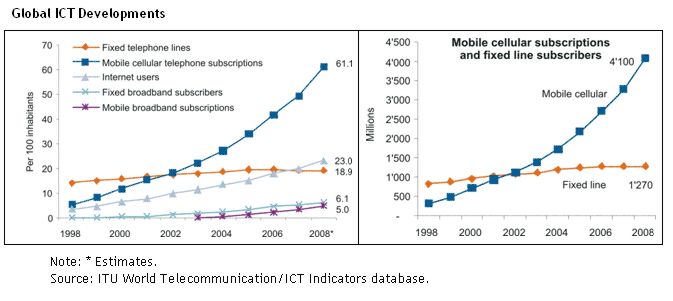
Well, here we are in 2010 and according to a UN report published in March 2009 it was estimated that there were already 4.1 billion mobile phone subscribers  at the end of 2008 (60% of the world population), with the fastest growing country being… Pakistan.

Additionally, it was noted that there had been a clear shift from fixed to mobile cellular phone use and that in the same reporting period there were over three times more mobile cellular phone subscriptions than fixed telephone lines globally. Two thirds of those mobile phones are found in the developing world compared to less than half in 2002.

Why does this matter?

Because among Gen Y (and younger) and throughout many parts of the developing world the cell phone or other mobile devices are becoming the first device of choice (or necessity) for interacting with the Internet, for making online purchases, for banking, etc… South Korea, a country considered to be at the leading edge of digital communications is a place now where nearly everything is done through your cell phone and the simple idea of getting a plastic card to use for purchasing is archaic and offered as a courtesy option to banking customers who think they might be traveling out of the country.

This leads us to another thing to be aware of when you look at that graph above. The racing climb of mobile devices also represents a growing class of web users that may be visiting your website, buying your products, trying to get customer support.

It was estimated that in 2008, the number of mobile Internet users had reached 1.05 billion, surpassing the number of PC web users (1 billion) for the first time ever.

The natural questions become, why isn’t your website mobile friendly? And, if you’re doing any kind of e-commerce, why isn’t your store front not only mobile friendly but able to accept payments in the common methods of payment frequented by your customer base?

If you don’t have the answer, your business could be in trouble. Even the best established business relationship or brand loyalty can dissolve in the blink of an eye when there is a major change in the way society communicates.

You can see this taking place right now across all aspects of the publishing world. Non-Internet based media companies have spent the greater part of decade trying to figure out how to apply their business models to Internet communications rather than the other way around. For example let’s take the contemporary case of the newspaper classifieds. Classifieds were the mainstay of newspaper revenue for over a hundred years in the U.S. but they were never a perfect process for users. Limited words, fees, trying to figure out what days you wanted your ad to show up… these things all presented challenges to customers using the service. Then a very basic website called Craigslist showed up which was free to read, free to post (short of fees for job postings and some services) and had no real limits on word counts or listing durations. Within a few short years the classifieds industry was decimated and many newspapers soon found themselves going out of business because they could not or would not adapt.

So let’s bring this all around… in short everything I’m talking about here relates to location and convenience. These fundamental elements have been key to business success since the dawn of time. Real-estate agents get it “Location, Location, Location!”. Traditional marketing people get it “Go to where the customers are”.

People are on the web, people are using their cell phones to use the web. People are using their cell phones for the majority of their day to day communications when you take in voice, SMS, web, chat, gaming, etc… Do your children have their own cell phone? Does each child have their own cell phone? When they grow up to be a consumer, will your company be positioned to communicate to them in a way that they expect to be talked to or are you simply expecting them to learn an archaic way to talk to you based on how you talk today? When you get that Fax with their answer let me know.

Get it? Good. Next you need to actually have something relevant on your website for visitors to see when they get there on their cell phone, but that’s another conversation all together.

My thanks to the following resources for my data:

  • http://communities-dominate.blogs.com/brands/2007/01/putting_27_bill.html
  • http://www.itu.int/newsroom/press_releases/2009/07.html
  • http://www.nytimes.com/2009/05/25/technology/25iht-mobile.html
  • http://wapreview.com/blog/?p=3019
  • http://www.tomiahonen.com/ebook/almanac.html
  • http://www.shirky.com/weblog/2009/03/newspapers-and-thinking-the-unthinkable/

May 6, 2009

Doing your homework

Filed under: General,Perspective,Sage Advice — Tags: , , , — Bryan @ 12:53 am

I can’t emphasize enough for people who want to jump on the social media bandwagon. DO YOUR HOMEWORK FIRST.

If you get invited to a party hosted by someone you don’t know, you might ask some questions “what kind of party is it?”, “what should I wear?”, “am I expected to bring a bottle of something to drink?”, “should I be on time or fashionably late?”, etc… You get the idea.

Think of social media in many ways as a world party. First a little secret though. I can tell you right now that by the time you hear about the next big thing you’re already fashionably late, so we can settle that question right away. If you by some happenstance find yourself as an early adopter though, you’ll know because you’ll be one of the people annoyed (oddly enough) that your world was just swamped with a million people who don’t know what they’re doing.

So anyways, you’re going to the big party now and you want to fit in with the cool kids right? Well that’s where you do your homework. First things first, go ask your friends and family if they’re already using the new thing. If anyone is already there, ask them for their perception of the social etiquette for the environment. Initially 95% of them will probably be wrong but listen anyways because right now you’re developing a consensus.

In the neutral scenario, you ask 100 people who all give you the same bad answer, at the least you’re following social norm so that’s a win of sorts. At best you find someone from the 10% crowd who’s totally up on everything and will give you the straight scoop. In the worst case you hook up someone from the opposite 10% who has less of a clue than you but are so emphatic with their bad advice that it all seems reasonable.

Next go to your favorite search engine and enter “_____ for noobs” where blank is the new thing (eg, Twitter). Now, just so you understand what you’ve just searched. Noobs is derogatory slang for the word Newbies which is itself effectively derogatory slang for the term New Users. Many people ignore the derogatory nature of these terms anyways and I wouldn’t let yourself get to upset over it either. It’s the fastest way to find the information and it’s the common term used within the community where many of these things start. The important thing here is to read through some of the pages that come up in your search, and take it all with a grain of salt. The people writing these pages are frequently early adopters who are complaining about the missteps of new users or they are existing users making a genuine effort to reach out and educate new users so the new users can integrate with the activity faster without annoying everyone else in the process and/or embarrassing themselves at the same time. For instance check out this slide show presentation on Twitter that came up as my first search result at the time of writing this. There are certainly some gems out there.

Beyond that, you’ll do yourself a big favor by going out and trying to learn what problem this new tool was invented to solve. For instance Blogs were originally created by people who wanted to keep a public journal of their lives for their friends to read. Maybe that’s not what it’s being used for by everyone now but it can clue you into a greater understanding of what may or may not be a successful tactic to take in using the new thing. I would suggest doing some research on Wikipedia but if you do remember that Wikipedia editors are like the guy at the big box store you paid to pre-assemble your kid’s new bicycle (secret, he’s just reading the instruction book and probably never assembled a bike before… just like you).

On a tangent note let’s through out an example, if your mom always roasts chicken upside down, are you going to do the same thing when you roast a chicken or are you going to ask her “why are you doing that?”. Maybe there’s a better way to roast a chicken and maybe your mom is doing this because that’s what her mother told her to do and she never asked. Seriously! Go get a cook-book and see how other people roast chicken. Maybe doing it mom’s way ends up being the best way but you’ll never know until you do your research (for the record my mom does not roast chicken up-side-down).

So what’s the bottom line? Soak it all in.

In general, if you take a day and study up on any given social media platform you’ll be able to glean enough information to know if it’s something you personally want to deal with. Remember just because the cool kids are using something doesn’t always mean its right for you and just because everyone else is jumping in head first doesn’t mean you have to as well. That, also doesn’t mean you should ignore it though. Step in and get you feet wet for a moment. Post a comment on someone’s blog. Be sensible. Think of it like the social event party where everyone is offering you a drink. You can skip the party, you can drink a soda pop, you can carry around the same bottle of warm beer for the next four hours, you can drink sensibly, or you can wake up the next day without a clue about what happened the night before. If you’re a grown adult, it’s your call. Just think about how you want to be perceived before you participate in the community.

April 30, 2009

To SEO or not to SEO, that is the question.

Filed under: General,Internet Rant,Perspective — Tags: , , , , , — Bryan @ 1:12 am

Most people at some point in their lives will hear the advice “If it sounds too good to be true, then it probably is” or maybe “there’s no such thing as a free lunch”. This is generally sound advice, and if nothing else it is good counsel to reduce the chance of becoming a victim of a confidence scam.

This leads me to today’s discussion about SEO companies. SEO stands for Search Engine Optimization and defines a company as one that will help your business improve how visible your website is in search results on sites like Google, Yahoo, Live Search or any of a dozen Internet search sites online. If you want the best search results for your site, you must optimize it for the search engines.

You don’t know what to do? Who can help?

There are two classifications of SEO companies. The first and best to work with are companies that will audit your website and give you valuable feedback on how to change your HTML page structure. How to present your web content on your site. How to added meta-data to your web pages that helps clue in the search engines as to what can be found on any given page. They will help you understand about all of the extra non-web page files that you can create for your web site that co-operates with the search engines to help them locate your content and best determine how to list it. They may even give you advice on ways to completely rethink exactly what content you should put on your site in order to achieve your online goals. In short an honest SEO company will be there to educate and inform you so that you can make the best decisions on how to engage the online aspect of your business and achieve a sustained level of visibility.

Additionally, they may counsel you on ways to build relationships with other sites to establish cross linking opportunities and how to go about presenting your site to the public in a clean and professional manner that helps you towards getting the traffic you want.

Some of these companies will even help you with this work for an added fee and provide full transparency with their operations, working with you much like a P.R. firm or Ad agency in helping maximize your URL and brand exposure. In fact some of them may work in tandem with your P.R. and/or Ad agency to potentially help take your brand to the next level of visibility. It’s going to be hard work and you better have good, strong content on your site. Why? Because, while you can spend a billion dollars and get a billion people to visit your site, if there isn’t anything there, they are not coming back and they are certainly not going to tell their friends about you (unless it’s to make fun of you).

Now, on the other hand, I suppose if all you want is a billion people coming to your web page and nothing more, then you can always engage with the other kind of SEO company… and unfortunately these guys are the predominant type in the industry.

This second group is the one that tells you “for X amount of dollars I can get you top ranking in Google in 30-days”. All you have to do is just kick back and watch the hit counter on your site climb. This frequently reminds me of the old “lose 30 pounds in 30 days” deal that may work, but by using it you are risking some seriously major health issues and in some rare cases… death.

That got your attention right? You’re sitting there thinking, “OK, now he’s done it, that’s over the top nobody ever died from using an SEO firm.” No… not literally. But many companies have paid a harsh penalty to their brand for some short term traffic gain. Take for instance BMW Germany’s and Ricoh’s brush with Google a couple of years ago.

So just what are these “unscrupulous cads” up to that’s so bad? Well, at their most fundamental level they are assisting your company to behave in a manor contrary to anything you or your peers might have done as a part of normal day to day business. For instance on the more bland but annoying side some of these SEO companies retain ownership of 1,000 or even 100,000 domains that literally contain nothing more than some web pages that point links to their clients in order to try and trick search engines into thinking that your site must be pretty darn popular to have 100,000 other sites linked to it.

At the other end of the spectrum, a tactic currently in use by some of these companies is to pay substandard wages to workers in third world countries to do nothing more than log into every single blog they can find on the Internet and post a comment that contains a link back to your site (be it in the comment directly or the homepage URL provided on the user profile). You’ll almost certainly have seen this on your own blog as a spam comment at some point.

In the BMW example above they were using an old trick of padding out lots of unrelated keywords in the metadata of dozens of web pages on their sites to trick search engines into thinking there was text on the pages that not only didn’t really exist but also redirected you to some other page when you actually got to their site. Effectively, this was gaming the results on words like “used cars” (in BMW’s case) so that BMW always came up on the first page of search results.

There are even companies that do this for other media types as well, such as video. In this case a company might take a video from your site and literally, litter it on every other video portal they can find and upload multiple copies of the video to each of those sites while doing nothing more than changing the length of the video, changing the title or description and having all of these bajillion copies of your video all have a reference link posted someplace that comes back to your web site. This may create the false impression that lots of video sites are linking back to your video site naturally and thus by link volume, artificially inflating the search visibility of your video content. Not only is this behavior discouraged by search engines, it is frequently a Terms of Service violation with sites like YouTube, et all. And, if caught, at best the offending up-loader’s account will get banned (that would likely be one of the dozens of accounts the SEO company has created on their service for doing this). At worst, the video site publicly denounces your use of an SEO firm to spam their portal.

Now that you have some examples of how this works what are the real risks?

Well, the first and foremost risk is for your company’s brand image. In the case referenced much earlier, both companies received a public black eye over their behavior and Google blacklisted BMW’s and Ricoh’s sites from the search index until their sites had been modified to stop their questionable behavior. Alternatively if the SEO companies botch their work badly enough you may be in for ridicule by the public at large or worse your customers. I suppose if you don’t mind the risk of your site getting delisted and having everyone get a laugh at your brands expense (the old “any press is good press” adage right?) then maybe this is just what the doctor ordered.

But don’t kid yourself. At best this second type of SEO operation is deceptive behavior and in the circles I run in, companies that perform this kind of work are considered unethical at best. Period.

Finally, back to the opening title for this post “To SEO or not to SEO, that is the question.” The answer is yes, search engine optimize your site, but mind who’s helping you do the work.

January 15, 2009

Persona = Brand

Filed under: General,Perspective — Tags: , , , , — Bryan @ 12:24 am

So now that I’ve introduced you to thinking about Brand You or as we’ve been calling it, your persona, let’s think about what I’ve said and consider how this applies to a businesses.

Haven’t you noticed? Companies have personalities. Companies go to great lengths through advertising and marketing to establish a brand identity (persona) knowing that more often than not you’re going to buy something from either someone you identify with, someone you know or someone you trust. When companies inundate you with messaging they are trying to establish this relationship on a pseudo subconscious level so that you’ll gravitate to their product when presented with a comparable set of options.

Here is an easy thought exercise for you the next time the TV is on. Actually watch the commercials. Based on time of day, day of week and commercial content you can almost always identify who that company thinks is watching the show that you are watching. In theory the persona they are attempting to identify with is supposed to ultimately be you. So that either you or someone you influence will buy the item (eg, kids and toys).

Now a more challenging one. Go to your cupboard or refrigerator and look at what you have in there. Ask your self “why did I first buy this <fill in the blank>?”. Inevitably for alot of people there will be something that falls under the “that’s what my mom bought me as a kid and it’s my favorite” category. Think about that…

Companies have two ways to bring you in as a customer. Positive referral from someone you have an relationship with or by creating a relationship via marketing so that, as I said above, when confronted between product A or B you go with what you know. All they have to do is get you to buy once and if you have a satisfying experience on your first try you may never try the other products. That’s one battle down in the war for your brand loyalty.

One extension of building brand loyalty is through lifestyle associations. Take for example the soft drink/soda business: Mountain Dew = extreme sports, Sprite = hip hop, Pepsi = young and young at heart, Coca-Cola = happy people, or Fresca = dieters. Companies play this card as one more relationship angle based on your personal identity with the hope that if you want to identify with your crowd you’ll buy their product. Sprite used this masterfully several years ago when they went after the Urban/Hip-Hop crowd or Mountain Dew with the extreme sports crowd.

Now maybe you can understand why companies go to great lengths to protect and promote their identity/persona/brand image. Or why when a company’s image is so badly damaged they change their name and logo and try to reinvent themselves. Good or bad, sometimes it works.

Worldcom -> MCI -> Verizon

THQ -> Atari

Enron -> CrossCountry

Philip Morris -> Altria

Related posts

Older Posts »